

Estimated Reading Time: 5 Minutes.
Indoor carbon dioxide (CO₂) levels are one of the most overlooked yet powerful indicators of building health. Facility managers are responsible for monitoring carbon dioxide levels for offices, schools, healthcare facilities, and public buildings, as it reveals the real-time signal of ventilation performance, occupant comfort, and potential health risk
No. 1: Redefine high CO₂ levels as the ‘silent drain’ of productivity.
Known as the colorless and odorless gas that is necessary to sustain life, CO₂ is also playing its significant role as the benchmark for globally known standards, including the WELL Building Standard and ASHRAE 62.1-2022. Bear in mind that CO₂ acts more than a mere number that shows up in air quality databases; in fact, it is also an important signal of how our bodies are impacted in terms of how we feel or think, especially for those who spend long periods in offices, factories, and commercial facilities.
Do you know sick-building syndrome is still an underrated workplace hazard in 2026? Read our article here to understand how it happens. Neglecting the accumulation of CO₂ levels can lead to a nonstop cycle of employees’ sickness symptoms, most commonly recognized as sick building syndrome; reduced cognitive performance; and unpromising results on your projects’ output. Hence, in this article we will break down thoroughly, piece by piece, why regular CO₂ monitoring is essential and how it should be given extra attention once an issue of elevated levels is discovered.

Busy workplaces lead to accumulated CO₂ levels.
No. 2: CO₂ monitoring really matters in hectic workforces.
Since CO₂ is a waste byproduct of the human respiratory system, it tends to rise sharply in overcrowded spaces with unbalanced airflow and poorly ventilated interior places such as meeting rooms or conference halls packed with participants, peak-hour office areas, and active gyms and fitness centers.
Most buildings will dilute high CO₂ concentrations by prioritizing a stable breeze of fresh air through the old-fashioned way of cross-ventilation (e.g., opening windows widely to allow cool currents to enter from outdoors to sheltered areas), which might be the temporary solution for the general public.
However, professional facilities nowadays are seeking positive changes in air quality—whether experienced establishments paired with outdated HVAC systems or young yet thriving startups—that will be seen to share the common idea of building an environment that keeps employees feeling sharp, focused, and in tip-top condition.
Explore projects that have been awarded WELL certification by the International WELL Building Institute™ here.
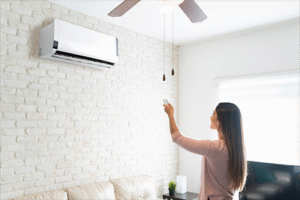
HVAC systems, windows, and fans are the most common ways to circulate air.
No. 3: There are Limitations of once-a-year ‘CO₂ spot checks.’
Some facility managers might think an occasional assessment is sufficient to address their company having ‘good air quality,’ but the truth is often devastating enough to dismantle this kind of delusion.
As a matter of fact, manual measurements hardly capture the whole picture of the dynamic fluctuations of CO₂ over time, since they only manage to offer limited data through a simple snapshot of your workplace at the moment. Try to understand that our air is flowing very quickly; your surrounding temperature, humidity, and emission of pollutants can vary even within a matter of hours. (Learn how temperature and humidity affect human bodies.)
Not only the size of a room, but also a variety of factors, including shifting occupancy patterns, seasonal HVAC schedules, varied room usage, and even the weather conditions, could negatively affect the precision of the detected data, causing a misleading outcome. Conversely, continuous CO₂ monitoring with real-time insights is the only useful approach in order to create a breathable environment.
When a single point-in-time measurement was not responsible for the ‘stale air’ problem, persistent observation empowers facilities to identify the zones that often have high-density CO₂, so HVAC systems could respond in time, rather than depending on sporadic usage. Aligning ventilation routines is helpful to save up energy expenses by shutting down unused systems during off-hours while ensuring compliance with strict environmental benchmarks mandated by WELL, LEED, and other local certifications.
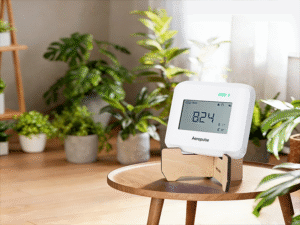
CO₂ sensors are great companions to your healthier journey.
With a portable air quality monitor that shows visible data, employees could examine workplaces using the following table as below:
|
CO₂ Levels (parts per million) |
Status |
Air Quality Explanation |
|
Below 800 ppm |
Optimal |
Aligned with WELL Building Standards. Good ventilation brings peak comfort, sustained focus, and better productivity. |
|
800-1,000 ppm |
Acceptable |
Stable, but stale air is likely. Calls for close observation. Ventilation is advised to prevent minor stuffiness. |
|
1,000-1,500 ppm |
Actionable |
Dropping cognitive performance. Violates standard IAQ policies. HVAC adjustments are encouraged. |
|
Above 1,500 ppm |
High Risk |
Showing physical disturbances such as headaches, fatigue, drowsiness. Significant cognitive decline. Immediate ventilation solutions are mandatory. |
No. 4: CO₂ monitors are definitely a must-have nowadays.
Air quality monitors are perceived by many as frauds or scams. Nonetheless, air quality is gradually accepted as a strategic asset that facilities must emphasize immediately. According to this article on Harvard Business Review written by Dr. Joseph G. Allen, director of the Healthy Buildings program at the Harvard T.H. Chan School of Public Health and a renowned industrial hygienist who helps Fortune 100 companies integrate air quality solutions into their international portfolios.
He claimed that the days of air transparency have arrived with affordable, handheld, yet professional sensors costing around $150 (imagine paying the same price for monthly medical insurance!). Bid farewell to waiting months for the assessment reports and the high budget of hiring an expert. Today, any employee in the global workforce is now available to deploy an air quality monitor with simple steps, gathering rudimentary data during hectic periods or times of crisis to review, analyze, and share.
Our Aeronode A200-CO2 is designed specifically for modern facility operations, which offers high-accuracy NDIR CO₂ sensing (400–10,000 ppm) in compliance with leading global standards such as ANSI/ASHRAE 62.1-2022, California Title 24, RESET® Grade B, and WELL Building Standard™ (WELL v2). Designed to optimize for professional and long-lasting performance, even with a 30-minute measurement interval going on with Wi-Fi connectivity, it still allows over 300 days of battery life.
For facilities and companies, A200-CO2 allows seamless integration with your HVAC infrastructure just by connecting BACnet/IP or Modbus building management. For individuals, it features flexible installation options for both wall-mounted and tabletop use. With clear data showing visual indicators and audible alerts via the mobile app and web dashboard, switching to proactive intervention is possible.
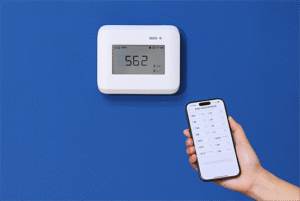
Visible data of CO₂ levels is often displayed in the mobile app.