

 The Importance of Indoor Air Quality (IAQ) for Businesses
Indoor Air Quality (IAQ) has become one of the most critical aspects of a healthy work environment. Poor IAQ can lead to a wide range of health issues, from headaches and fatigue to respiratory problems and cognitive impairments. As businesses continue to navigate post-pandemic challenges and adapt to remote and hybrid work models, ensuring safe, clean indoor air is essential to maintaining employee health, productivity, and overall well-being.
But what happens when IAQ goes awry? That’s where an IAQ Emergency Response Plan becomes crucial. Much like any emergency plan for fire, electrical issues, or natural disasters, an IAQ emergency response plan ensures your company is prepared to handle sudden changes in air quality that could put health at risk.
What Is an IAQ Emergency Response Plan?
An IAQ emergency response plan is a documented set of procedures designed to manage and address poor air quality events in the workplace. This can include sudden spikes in pollutants like CO₂, VOC emissions, or hazardous materials like formaldehyde or ozone.
The plan outlines:
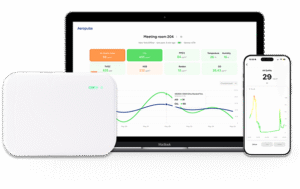
1.How to detect poor indoor air quality – Using continuous monitoring systems such as Aeropulse sensors.
2.Immediate actions – For instance, increasing ventilation, activating air purifiers, or evacuating affected areas.
3.Long-term solutions – Updating HVAC systems, increasing filtration, or improving building sealing.
4.Training – Ensuring employees know how to react in case of an air quality emergency.
Why IAQ Emergency Response Plans Matter
The risks of neglecting IAQ go beyond discomfort to poor air quality can lead to a host of serious health problems. For businesses, poor air quality impacts:
1.Employee health and safety – Prolonged exposure to poor IAQ can lead to respiratory issues, allergies, or even more severe long-term effects.
2.Productivity – As IAQ degrades, cognitive performance, focus, and energy levels drop.
3.Regulatory compliance – Companies in certain industries must comply with IAQ regulations such as WELL, LEED, and ASHRAE standards. Failure to maintain proper IAQ could result in legal consequences or lost certification status.
Without an effective emergency plan, businesses risk not only employee health but also their reputation and operational efficiency. For this reason, integrating continuous IAQ monitoring and a clear emergency response procedure is a proactive approach to business continuity.

Case Study: How a Modern Office in Shenzhen Addressed IAQ Challenges
In a newly renovated office building in Shenzhen, facility managers faced a pressing issue. The building had adopted a hybrid work model, with employees working both in-office and remotely. However, the building’s ventilation system was running at full capacity all day long, leading to unnecessary energy waste and significant CO₂ spikes, especially during peak afternoon hours when occupancy increased.
The facility team realized that the lack of real-time IAQ monitoring was contributing to inefficient energy usage and poor air quality, which could potentially lead to discomfort and health issues. It was clear that an IAQ emergency response plan was needed to manage this ongoing issue.
The Aeropulse Solution
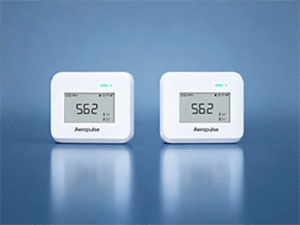
To tackle this problem, the facility managers deployed Aeropulse A100 and A200 CO₂ monitors across the building. These monitors, which measure CO₂, temperature, humidity, and other key air quality metrics, provided real-time data to the Aeropulse dashboard, enabling the facility team to track IAQ in real-time.
Within two weeks of monitoring, the data revealed a few key insights:
- HVAC systems were operating at full capacity despite low occupancy during the morning hours.
- CO₂ spikes occurred in meeting rooms during the afternoon.
- Several spaces were over-ventilated, wasting energy, while others were under-ventilated.
Using these insights, the facility team created an IAQ emergency response plan. The plan included demand-controlled ventilation (DCV) using CO₂ thresholds from the Aeropulse dashboard. This adjustment enabled the HVAC system to operate only when CO₂ exceeded a set threshold, significantly reducing energy consumption.
Results of the IAQ Emergency Response Plan
After three months of deploying the system, the results were remarkable:
|
Metric |
Before Aeropulse |
After Aeropulse |
Improvement |
|
HVAC Runtime |
100% |
72% |
-28% |
|
Average CO₂ Spikes |
1,450 ppm |
780 ppm |
Healthy & WELL-aligned |
|
Monthly Energy Cost |
Baseline |
-18% |
Significant savings |
|
Occupant Complaints |
Frequent |
Rare |
Comfort improved |
The facility’s energy consumption decreased by 28%, CO₂ levels were brought into WELL-aligned ranges, and occupant complaints about air quality were reduced dramatically. The company saved 18% in monthly energy costs while improving overall comfort for employees.
How Aeropulse Supports Your IAQ Emergency Response Plan
Aeropulse’s A200 series and A100 monitors provide the real-time data needed to create an effective IAQ emergency response plan. By using continuous IAQ monitoring, businesses can ensure they are always prepared for sudden changes in air quality. Here’s how Aeropulse helps:
- High-accuracy sensors for CO₂, temperature, humidity, and other key metrics.
- Real-time alerts when pollutants exceed set thresholds.
- Data logging for trend analysis and emergency response tracking.
- Cloud dashboard and mobile app for remote monitoring and reporting.
By deploying Aeropulse devices, businesses can create a safer and more comfortable environment, manage energy use efficiently, and ensure compliance with global standards like WELL and LEED.

Conclusion: The Need for an IAQ Emergency Response Plan
An IAQ emergency response plan is not just a theoretical concept it’s a practical necessity for modern businesses. Whether it’s responding to unexpected spikes in CO₂, VOCs, or other pollutants, businesses need a clear and actionable strategy to protect employees and ensure compliance.
Aeropulse’s continuous IAQ monitoring provides the data necessary to support these emergency response plans, helping companies avoid health risks, reduce energy waste, and improve overall workplace satisfaction. By using real-time monitoring and smart ventilation control, businesses can maintain optimal air quality, contributing to better employee performance and a healthier workplace environment.