

 The Invisible Threat in Modern Buildings
When we think of air pollution, we usually imagine smog-filled skies or traffic exhaust. But there’s another pollutant completely invisible and odorless that surrounds us indoors every day: carbon dioxide (CO₂).
While CO₂ is a natural component of the atmosphere, its accumulation indoors can directly affect how people feel and perform. As buildings become more energy-efficient and airtight, fresh air exchange is often reduced, trapping CO₂ and other contaminants inside.
The result? A decline in comfort, focus, and even overall health.
Why Indoor CO₂ Monitoring Matters?
Indoor environments offices, classrooms, homes can easily exceed 1,000 parts per million (ppm) of CO₂ when ventilation is poor. At these levels, research shows people begin to feel tired, unfocused, and sluggish.
At concentrations above 1,500 ppm, studies have linked high CO₂ to reduced cognitive performance, slower reaction times, and decreased productivity.
Monitoring CO₂ continuously allows building operators, employers, and homeowners to:
- Identify poor ventilation before it becomes a problem
- Adjust HVAC systems for optimal air exchange
- Maintain fresh, oxygen-rich environments
In short, CO₂ monitoring turns invisible air quality data into actionable insights ensuring that occupants stay alert, healthy, and productive.

CO₂ and Human Performance: The Science Behind It
When CO₂ levels rise, the proportion of oxygen in the air slightly decreases. Our brains are extremely sensitive to these small changes.
High CO₂ can cause:
- Headaches and dizziness
- Reduced concentration and decision-making ability
- Increased fatigue
- A sense of stuffiness or discomfort
In workplaces, this translates into reduced employee productivity. In schools, it affects student focus. In healthcare settings, it can impact patient recovery and staff efficiency.
That’s why CO₂ isn’t just an environmental concern it’s a performance and wellness factor.

Global Standards for CO₂ Levels
Modern building standards such as WELL, LEED, and RESET have established benchmarks for acceptable indoor CO₂ concentrations:
- WELL Building Standard: Recommends indoor CO₂ levels remain below 800 ppm for optimal air quality.
- LEED (Leadership in Energy and Environmental Design): Encourages continuous CO₂ monitoring to ensure adequate ventilation and occupant comfort.
- RESET Air: Sets real-time monitoring requirements for CO₂ as part of its ongoing air quality certification.
Meeting these standards demonstrates not only compliance but also a commitment to occupant health and environmental sustainability.
How CO₂ Is Measured: The Technology Explained
Modern CO₂ monitoring devices rely on NDIR (Non-Dispersive Infrared) sensors. This technology detects CO₂ concentration based on how infrared light is absorbed by gas molecules.
Key advantages of NDIR sensors include:
- High accuracy and stability
- Long lifespan with minimal calibration
- Low energy consumption
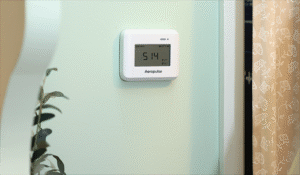
The Aeropulse A200 utilizes NDIR sensing to deliver precise, real-time readings of CO₂, temperature, and humidity.
Through the Aeropulse Dashboard and mobile app, users can view live air quality data, receive automated alerts, and track long-term performance all from one platform.
The Aeropulse Advantage: Smart CO₂ Monitoring
What sets Aeropulse apart is its integration of smart connectivity and intuitive data visualization.
The A200 series connects via Wi-Fi and works seamlessly with the Aeropulse Dashboard as an interactive cloud platform designed for air quality management.
This enables:
- Real-time monitoring across multiple rooms or buildings
- Automatic reporting for WELL or LEED documentation
- Custom alerts when CO₂ levels exceed safe thresholds
Aeropulse solutions empower organizations to move from reactive to proactive air quality management, ensuring healthier environments and enhanced occupant well-being.
Toward Healthier Indoor Spaces
The importance of CO₂ monitoring extends far beyond numbers on a screen. It’s about creating spaces where people can think clearly, breathe easily, and perform at their best.
In a world where indoor air often goes unnoticed, Aeropulse provides the tools to make it visible and manageable.
By adopting smart monitoring solutions like the Aeropulse A200, building operators and facility managers can achieve healthier, more sustainable, and WELL-certified environments.

Conclusion:
CO₂ monitoring is the cornerstone of healthy indoor air quality. It supports better decision-making, comfort, and compliance with global standards while helping organizations achieve sustainability and wellness goals.
With Aeropulse, every breath is a step toward a healthier, smarter, and more productive indoor world.