
 Carbon dioxide (CO₂) monitoring has become a core requirement for healthy buildings, schools, and workplaces. As awareness grows, the market is flooded with low-cost CO₂ sensors promising instant results at very low prices.
But not all CO₂ sensors are created equal.
Understanding the difference between cheap consumer-grade CO₂ sensors and professional-grade monitoring devices is critical for facility managers, building owners, and organizations pursuing standards like WELL, LEED, and RESET.
This article breaks down the real difference in accuracy, reliability, calibration, lifespan, and compliance so you can make an informed decision.
Why CO₂ Monitoring Accuracy Matters
CO₂ is widely used as a proxy for ventilation effectiveness and occupancy. Decisions based on CO₂ data directly affect:
- Indoor air quality (IAQ)
- Cognitive performance and comfort
- HVAC operation and energy use
- Compliance with green building certifications
If the data is wrong, every decision that follows is also wrong.
Sensor Technology: The Core Difference
Cheap CO₂ Sensors
Many low-cost devices do not measure CO₂ directly. Instead, they use:
- eCO₂ (estimated CO₂) derived from VOC readings
- Algorithms that guess CO₂ levels rather than measuring them
These sensors can appear responsive but often produce misleading values, especially in real-world environments.
Professional-Grade Devices
Professional monitors use NDIR (Non-Dispersive Infrared) sensors, the global standard for CO₂ measurement.
NDIR sensors:
- Measure CO₂ molecules directly
- Are unaffected by VOCs or humidity
- Maintain accuracy over long periods
This is the technology required for WELL, LEED, RESET, and ASHRAE compliance.
Accuracy and Drift Over Time
Cheap Sensors
- Accuracy may be acceptable out of the box
- Drift significantly over time
- Rarely specify long-term stability
- Often lack recalibration options
After a few months, readings may be off by hundreds of ppm without any warning.
Professional Devices
- Clearly specified accuracy (e.g., ±30 ppm ±3%)
- Designed for multi-year stability
- Drift compensation built into firmware
- Support calibration or sensor replacement
This reliability is essential for continuous monitoring and auditing.
Calibration and Data Trustworthiness
Cheap Sensors
- Often factory-calibrated only
- No user-accessible calibration
- No transparency on calibration methodology
- Readings cannot be validated
This makes them unsuitable for regulated or professional environments.
Professional-Grade Devices
- Support baseline or sensitivity calibration
- Provide traceable measurement methods
- Allow facility teams to maintain data integrity
- Accepted by certification bodies
Without calibration, CO₂ data cannot be trusted no matter how good it looks on a screen.
Data Logging, History, and Reporting
Cheap Sensors
- Display-only or short-term data
- No long-term storage
- Limited or no data export
- Not suitable for audits or compliance reporting
Professional Devices
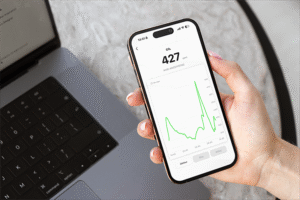
- Continuous data logging (minute-level averages)
- Long-term storage (often 1+ years)
- Cloud dashboards and data export
- Required for WELL Feature A08 and LEED reporting
Historical data is critical for identifying trends, verifying ventilation performance, and proving compliance.
Integration With Building Systems
Cheap Sensors
- Standalone devices
- No integration with HVAC or BMS
- Manual interpretation required
Professional-Grade Devices
- Support protocols like Wi-Fi, MQTT, Modbus, BACnet
- Enable demand-controlled ventilation (DCV)
- Integrate with smart building platforms
This allows buildings to optimize ventilation without overusing HVAC, saving energy while protecting health.
Compliance With Standards and Certifications
Cheap sensors are not accepted for:
- WELL Building Standard
- LEED v5
- RESET Air
- Occupational IAQ audits
- Government or school reporting
Professional-grade devices are designed specifically to meet these frameworks, with documented accuracy and reliability.
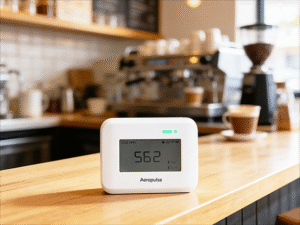
How Aeropulse Fits into Professional-Grade Monitoring
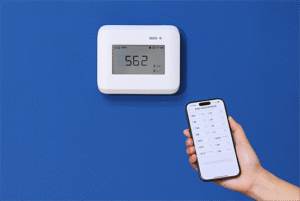
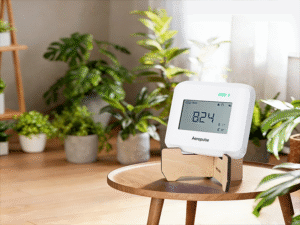
Aeropulse CO₂ monitors are designed for real-world building performance, not just basic awareness.
- NDIR CO₂ sensing aligned with ASHRAE 62.1
- Long battery life or wired operation
- Continuous data logging with cloud access
- Alerting and reporting for compliance
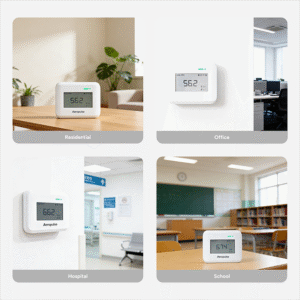
- Designed for offices, schools, healthcare, and public buildings
Devices like the A200-CO₂ deliver professional accuracy in a form factor suitable for both new and existing buildings.
The Real Cost of “Cheap” CO₂ Sensors
While low-cost devices may seem attractive, they often lead to:
- Incorrect ventilation decisions
- Poor indoor air quality
- Missed compliance requirements
- False confidence in building performance
In contrast, professional-grade monitoring provides reliable data, better occupant outcomes, and long-term value.
Conclusion
The difference between cheap CO₂ sensors and professional-grade devices is not just price it’s data integrity, compliance, and trust.
For buildings that care about health, performance, and certification, accurate CO₂ monitoring is not optional. Investing professional-grade devices ensures that every ventilation decision is based on data you can rely on.
Aeropulse supports this shift by providing accurate, scalable CO₂ monitoring solutions built for modern, health-focused buildings.