

 As companies shift toward healthier workplace design, indoor air quality (IAQ) has become one of the most important factors affecting employee safety and productivity. Among the many IAQ risks, poor ventilation remains a key contributor to the spread of airborne diseases such as influenza, COVID-19, RSV, and other respiratory infections.
When offices lack sufficient fresh air exchange or fail to dilute indoor pollutants, airborne pathogens remain suspended in the air for longer periods, making transmission far more likely. For modern workplaces, understanding and improving ventilation is no longer optional; it is a core part of employee protection and smart building management.
In this article, we break down how ventilation affects disease transmission and how IAQ sensors help offices control risk.
Why Ventilation Matters: The Science of Airborne Transmission
Airborne viruses and bacteria spread primarily through aerosols with tiny particles that people release when talking, breathing, or coughing. These aerosols can stay in the air for minutes or even hours.
When ventilation is poor:
- Indoor air becomes stagnant
- Infectious aerosols accumulate
- CO₂ levels rise (indicating high rebreathed air)
- Pathogens spread more easily across shared spaces
This is why ventilation is one of the leading indicators of infection risk, a fact recognized by ASHRAE, WELL, LEED, and the CDC.
Signs of Poor Ventilation in Office Settings
Common indicators include:
- High CO₂ levels (above 1,000 ppm)
- Employees reporting fatigue or headaches
- Stuffy or humid air
- Odors lingering for long periods
- Frequent outbreaks of colds or flu among staff
- Condensation on windows (low air exchange)
How Poor Ventilation Increases Airborne Disease Spread
- Higher Concentration of Viral Aerosols
Low fresh air exchange means viruses accumulate instead of being diluted or exhausted outdoors.
- Higher CO₂ = Higher Rebreathed Air
CO₂ is not harmful by itself at low levels, but it is a performance indicator of how much exhaled air is circulating.
- 600–800 ppm → good ventilation
- 1,000+ ppm → poor ventilation, high infection risk
- Humidity Levels Affect Virus Survival
Viruses survive longer in very dry indoor air. Poor ventilation usually leads to unstable humidity (either too dry or too humid).
- HVAC Shortcuts Spread Contaminants
Some outdated HVAC systems recirculate indoor air without filtering or diluting it spreading pathogens from room to room.
Recommended Ventilation & IAQ Targets for Offices
Aligned with WELL, ASHRAE 62.1, and LEED v5:
|
IAQ Parameter |
Recommended Range |
|
CO₂ |
Below 800 ppm |
|
Ventilation Rate |
Per ASHRAE 62.1 minimums |
|
PM2.5 |
Below 12 µg/m³ |
|
Relative Humidity |
40–60% |
|
Outdoor Air Intake |
Maximize when occupancy rises |

How IAQ Sensors Reduce Airborne Disease Risk
Modern buildings now integrate real-time IAQ sensors to continuously track health-critical parameters such as:
- CO₂ (ventilation indicator)
- PM2.5 (airborne particles)
- Temperature & humidity
- VOC buildup
- Occupancy patterns
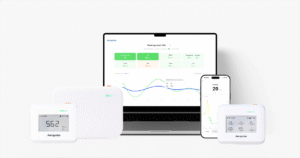
Solutions like Aeropulse A100 and A200 sensors allow facility managers to:
- Detect ventilation problems instantly
- Automate fresh air intake based on CO₂ thresholds
- Verify HVAC performance
- Keep indoor spaces aligned with WELL & LEED health standards
- Provide transparent IAQ data to employees
SEO Keywords Used: IAQ sensors, CO₂ monitoring, smart ventilation, Aeropulse air quality monitor, WELL Building Standard air quality.
Practical Ways to Improve Ventilation in Offices
- Increase outdoor air intake rates
- Use demand-controlled ventilation (DCV) driven by CO₂ sensors
- Open windows when possible
- Install HEPA or MERV 13+ filtration
- Keep humidity between 40–60%
- Reduce overcrowding in meeting rooms
- Add portable purifiers (ozone-free) in high-risk zones
Conclusion: Healthy Ventilation = Healthy Offices
Poor ventilation is one of the biggest contributors to airborne disease transmission in offices, but it is also one of the easiest problems to solve. With real-time IAQ monitoring, proper ventilation strategies, and adherence to WELL and ASHRAE guidelines, companies can dramatically improve:
- Employee health
- Productivity
- Comfort
- Absenteeism rates
Modern offices that prioritize IAQ are not just safer, they are smarter, more efficient, and better places to work.