

Estimated Reading Time: 5 Minutes.
Why Is CO₂ Monitoring Essential
As a natural gas essential to life, this colorless and odorless gas is playing its protective part in our respiratory system, where carbon dioxide (CO₂) is known to be produced intracellularly in bodies by metabolism, eventually leaving the body as a waste byproduct through exhalation. Undisrupted respiration is responsible for balanced CO₂, which is vital in maintaining blood pH, facilitating oxygen (O₂) delivery to tissues, and supporting energy production that keeps you thriving every day.
Despite its important presence in our activities, it has given us an image that it seems relatively nontoxic under certain atmospheric conditions. However, studies have shown that being exposed to irregular rising or dropping in CO₂ levels, for example, prolonged exposure up to 5,000 ppm or 0.5% in concentration, may cause physical disturbances such as headache, dizziness, brain fog, fatigue, and freezing extremities, in extreme cases leading to impaired consciousness or death.

How Office Buildings Are Trapping CO₂
Indoor CO₂ levels are, in fact, generally higher than outdoors (typically ranging from 420 to 500 ppm), as overcrowded, high occupancy tends to increase CO₂ in enclosed spaces, combined with poorly managed ventilation due to outdated heating, ventilation, and air conditioning (HVAC) systems and the airtight construction designed for energy efficiency, somehow worsening the matter.
Keep in mind that the acceptable CO₂ levels indoors can vary depending on environmental factors such as the number of occupants and the size of a certain space. But its levels should be highly regulated at approximately 800 ppm (parts per million) to 1,000 ppm (or 0.04% CO₂ in air by volume) for well-being. Siemens indicates that when CO₂ levels are kept below 1,000 ppm, productivity gains range from 2% to 18%. Whereas elevated indoor CO₂ measurements, around 2000 ppm to 5000 ppm, may need more ventilation actions; otherwise, individuals will result in complaints of stagnant air, drowsiness, and loss of focus.
According to the U.S. Environmental Protection Agency, inadequate ventilation is cited to trigger “Sick Building Syndrome (SBS),” a building-related illness where occupants develop unwell discomfort of sensory irritation, tiredness, difficulty concentrating, and more. Hence, indoor CO₂ monitoring has been introduced as a ventilation indicator to help prevent the occurrence of airborne diseases. Organizations like ASHRAE provide in-depth information in the Indoor Air Quality Guide, implying the potential long-term effects of exposure to CO₂ and strategies for achieving multiple critical IAQ objectives. It demonstrates that the availability of affordable air quality monitors is a proven benefit in supporting sustainability.

Ways to Deduct CO₂ In Stuffy Offices
A paper from Harvard University proved that CO₂ has a positive impact on an individual’s cognitive functions, stating that a green office environment has a huge increase of 61% compared to a conventional building condition, on average.
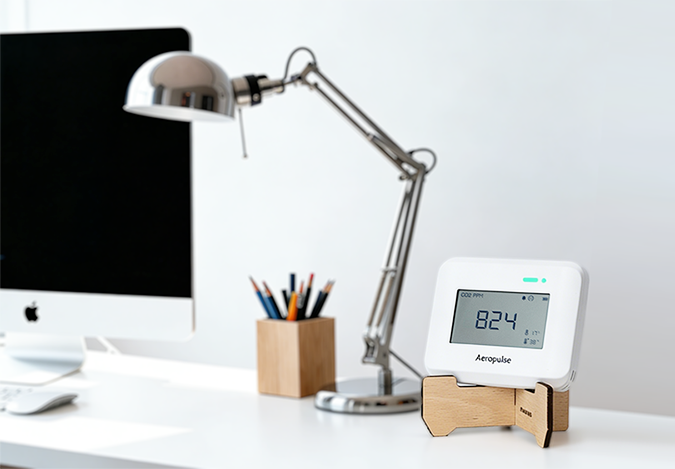
First off, CO₂ monitors should be installed in order to identify the situation and detect any possible obstacles. Offices often are recommended to aim for a safe level of precisely 600 ppm to 1,000 ppm. A200-CO₂ allows occupants to act promptly before experiencing the consequences of overexposure. By monitoring real-time data continuously, these measurements help open-plan areas and meeting rooms elevate the risk of transmitting airborne diseases and infectious aerosols. Timely alerts will be issued whenever consistently high readings are detected. CO₂ levels could serve as a practical way to verify if the ventilation system is operating and meeting established IAQ standards, regulations, and guidelines.
Once we handle the data, it can be processed and support decision-making for improved IAQ performance. This is when Demand-Controlled Ventilation (DCV) steps in to adjust air changes in small and large buildings alike. As employees arrive at the start of the workday, a proper functioning DCV system will be a great help in improving air quality by automatically scaling air changes and making airflow adjustments in occupied spaces. Since CO₂ levels rise in direct correlation with occupancy, the DCV system acts as a set of responsive lungs for the entire building by taking in fresh air precisely when and where it is needed.
While legacy systems do carry a certain character, what defines a building’s legacy lies within the modernization via an optimized HVAC system. Although buildings made in the past were often built airtight in order to maximize energy efficiency and minimize moisture infiltration levels, the cons of this approach are seen as a direct trade-off between thermal insulation and human health. Nowadays, the advancement of HVAC technology centers on intelligent control systems powered by Internet of Things (IoT) networks. By syncing the scheduling data and occupancy sensors, the latest system initiates a pre-purge of fresh air ten minutes prior to employees’ arrival, resulting in flat CO₂ levels throughout the day.
Case Study: Making Newly-Renovated Office Buildings Healthier
Our Aeropulse’s product assisted a long-standing issue of balancing energy savings with comfort at work at a six-story office building in Shenzhen.
It all started when the managers of the facility noticed that the building wasn’t being used the way it was meant to be. Despite the fact that their HVAC system was operating at full capacity during periods of low occupancy, the outcome was not promising. Not only was there excessive energy consumption, but carbon dioxide levels were still spiking high during the workday’s afternoon, causing unstable temperature and airflow levels, while employees complained about stuffy air and productivity issues.
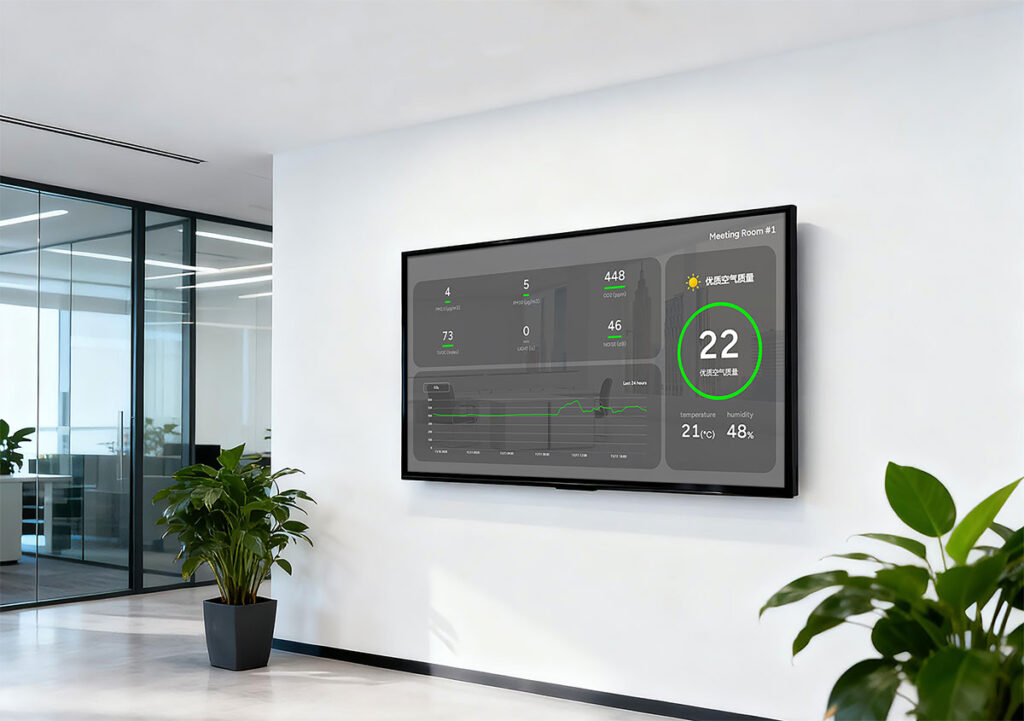
To fix these problems, the management team set up a wide range of Aeropulse A100 and A200-CO₂ monitors in meeting rooms, open offices, and training areas. Over time, it provides continuous, real-time data that lets the office switch from an outdated HVAC system to a demand-controlled ventilation (DCV) model. The air quality monitors also optimize energy efficiency by providing clear data to reduce baseline ventilation during vacant hours and strategically deactivating airflow in unoccupied zones.
Furthermore, by utilizing a 900 ppm CO₂ level as a dynamic trigger for increased ventilation, the facility ensures a high-performance indoor environment while significantly lowering overhead costs and mechanical wear.
The Results: A Three-Month Performance Review
Following the implementation of Aeropulse’s air quality monitors, this office building achieved measurable improvements in both operational costs and environmental quality. Monthly energy expenditures dropped by 18%, driven by the efficiency of the demand-controlled model. Air quality saw a parallel enhancement, with average CO₂ spikes reduced from 1,450 ppm to a healthier 780 ppm. Consequently, occupant satisfaction improved as employees’ complaints regarding air quality and thermal comfort decreased significantly.
Through a proactive approach in monitoring indoor air quality, Aeropulse helps identify the root causes of carbon dioxide accumulation and streamlines the management of indoor atmospheres with precise, actionable data that empowers a better working experience for all occupants.