

Why sensor quality determines the reliability of indoor air data and how Aeropulse ensures long-term performance.
Indoor air quality (IAQ) is no longer a “nice-to-have.” Schools, workplaces, hospitals, and smart buildings now rely on sensors to make decisions about ventilation, energy use, and occupant health.

But not all air sensors are equal.
When choosing an IAQ device whether for CO₂, PM2.5, temperature, humidity, or ozone, there are three concepts matter the most:
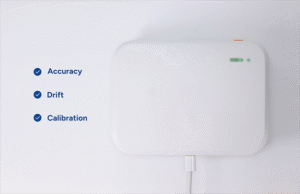
Accuracy | Drift | Calibration
These factors determine whether your air quality data can be trusted. Here is what they mean and how Aeropulse ensures that buildings receive high-precision, stable, and reliable measurements.
1. What Sensor Accuracy Really Means
Accuracy describes how close a sensor’s measurement is to the real value.
For example:
If the real CO₂ level is 800 ppm:
- A high-accuracy sensor may read ±30 ppm
- A low-quality sensor may read ±150 ppm or more
Why accuracy matters
Ventilation decisions, WELL/RESET compliance, and energy optimization all depend on precise data.
A device that is off by 150–200 ppm may:
- Trigger ventilation too early → wastes energy
- Trigger it too late → CO₂ spikes, decreased cognitive performance, and complaints
- Fail WELL Feature A08 or RESET accuracy requirements
Aeropulse Accuracy Standards
- A100 & A200 CO₂ sensors: ±30 ppm ±3% (NDIR — industry gold standard)
- ASHRAE 62.1-2022 compliant
- Factory-calibrated for stable, long-term performance
This is one of the highest accuracy levels available in commercial IAQ devices.
2. What Sensor Drift Is and Why It Matters
Drift is how much a sensor’s accuracy decreases over time.
All sensors drift the question is HOW FAST.
Low-cost sensors can drift within weeks or months, leading to:
- False alarms
- Incorrect CO₂ readings
- Inconsistent indoor air quality reporting
- Non-compliance with WELL, RESET, LEED, and Fitwel requirements
Why drift happens
- Dust accumulation
- Temperature & humidity stress
- Aging electronic components
- Poor calibration algorithms
Aeropulse Drift Prevention
Aeropulse devices use:
- High-grade NDIR CO₂ sensors with proven low drift
- Onboard compensation algorithms
- Automatic baseline correction (ABC)
- Temperature & humidity compensation
This ensures readings stay stable for years, not months.
3. Calibration: The Foundation of Reliable IAQ Data
A sensor is only as good as its calibration.
Two types of calibration:
- Factory calibration (performed before shipping)
- Field calibration (performed automatically or manually after installation)
Why calibration matters
Without proper calibration, even a high-quality sensor will slowly become inaccurate.
Aeropulse Calibration Assurance
- Pre-calibrated at the factory
- Automatic baseline calibration
- No manual calibration required in most environments
- Long-term stability validated with 1.5 years of logging memory
This reduces maintenance and ensures consistent sensor reliability.
4. Why These Factors Matter for Smart Buildings
WELL, RESET, LEED, and Fitwel all require:
- High accuracy
- Stable readings over time
- Reliable calibration
- Continuous monitoring
If the sensor is wrong, the entire building strategy becomes wrong.
This is why the A100 and A200 were engineered around accuracy, stability, and long-term data validity.

Case Study: How a University Innovation Lab Improved CO₂ Accuracy & Reduced Sensor Drift with Aeropulse Devices
Background
A technology innovation lab at a European university relied on several low-cost air sensors to monitor CO₂ and temperature for research and student projects.
After only 6–8 months of use, the team noticed clear inconsistencies:
- CO₂ readings varied by +/- 300 ppm between devices placed side-by-side
- Sensors drifted significantly during high-occupancy workshops
- Calibration attempts failed because the sensors lacked baseline stability
- Temperature offsets increased over time, affecting energy-modeling studies
The lab needed accurate, low-drift sensors for precise research applications.
The Aeropulse Solution
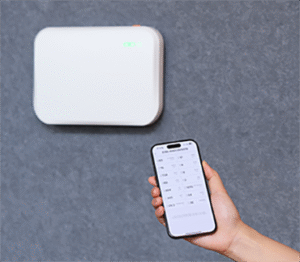
The university replaced its mixed set of sensors with Aerosense A100 and A200 monitors, chosen specifically because:
- They use NDIR CO₂ sensing, which has naturally low drift
- The accuracy is compliant with ASHRAE 62.1-2022
- Devices support automatic baseline calibration (ABC) and manual calibration
- Sensors store 1.5 years of 1-minute data, ideal for research trends
- Multi-parameter monitoring (CO₂, temp, humidity) enables cross-analysis
Devices were installed in:
- Three innovation labs
- Two seminar rooms
- One student coworking space
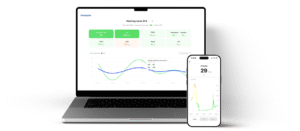
All units reported to the Aeropulse cloud dashboard for comparison.
Findings After 60 Days
1. Accuracy Verification
Aerosense monitors placed side-by-side differed by less than 20 ppm, compared to 300+ ppm deviation with previous devices.
2. Drift Reduction
The lab observed stable readings even during peak CO₂ events (2,000+ ppm during workshops), with no noticeable drift during the 60-day test.
3. Faster Calibration Cycles
Manual calibration time dropped from 15 minutes to 3 minutes per device, thanks to Aeropulse’s stable baseline and guided calibration mode.
4.Research Reliability
Students used the data for energy modeling, and professors noted:
- More consistent CO₂ profiles
- Fewer outlier spikes
- Stronger correlation between occupancy and IAQ conditions
Results Summary
|
Metric |
Before Aeropulse |
After Aeropulse |
Improvement |
|
CO₂ sensor deviation |
±300 ppm |
±20 ppm |
93% more consistent |
|
Drift per month |
5–8% |
<1% |
Long-term stability |
|
Calibration frequency |
Weekly |
Every 3 months |
Effort reduced |
|
Research data rejection rate |
22% |
3% |
Much higher data quality |
Conclusion
Choosing the right air sensor is not about appearance or features; it’s about data reliability.
To create healthier, more efficient buildings, your sensors must have:
✔ High accuracy
✔ Low drift
✔ Stable calibration
✔ Long-term performance
✔ Trusted NDIR technology (SenseAir)
This is why the Aeronode A100 and A200 are used in smart buildings, schools, and commercial spaces across Asia, Europe, and North America.
Accurate data → Better ventilation decisions → Healthier spaces → Lower energy costs.
