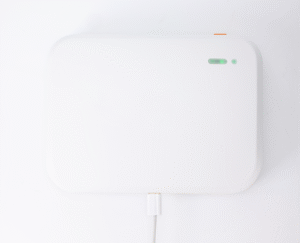

 As sustainable building standards continue to rise globally, indoor air quality (IAQ) has become a core requirement for achieving healthy, efficient, and future-proof buildings. Certifications like LEED, WELL, Fitwel, RESET, BREEAM, and others now integrate clear performance thresholds and monitoring expectations, making IAQ an essential metric not an optional feature.
For project owners, designers, and facility managers, understanding how these certifications define air quality is key to meeting compliance and improving occupant health. This guide breaks down the major frameworks and their IAQ requirements.
Why Indoor Air Quality Is Central to Modern Building Standards
Sustainable building certifications aim to reduce environmental impact, improve operational efficiency, and most importantly support occupant health.
Indoor air quality has become a priority because:
- People spend over 90% of their time indoors
- Poor IAQ contributes to headaches, fatigue, asthma, eye irritation, and long-term respiratory issues
- HVAC systems and building materials can emit pollutants
- Smarter monitoring now makes IAQ easy to measure and verify
Today, IAQ performance is not just a “nice to have”; it is a core sustainability and wellness metric.
LEED v5: Air Quality for Energy-Efficient and Low-Impact Buildings
LEED (Leadership in Energy and Environmental Design) is one of the world’s most recognized sustainability certifications.
LEED v5, its newest version, places even greater emphasis on indoor environments and real-time performance.
 Key IAQ requirements in LEED:
- PM2.5, CO₂, and TVOC monitoring
- Outdoor air ventilation calculations
- Low-emitting materials (paints, adhesives, flooring)
- Enhanced air filtration with MERV 13 or equivalent
- Post-construction air quality testing
- I-AQ performance reporting for credits
LEED promotes buildings that are both energy-efficient and safe for long-term occupancy.
WELL Building Standard: The Global Benchmark for Healthy Buildings
WELL, focuses primarily on human health, making IAQ one of its most detailed sections.
WELL, IAQ Targets Include:
- Ozone (O₃)
- PM2.5 & PM10
- Nitrogen dioxide (NO₂)
- VOCs and formaldehyde (HCHO)
- Carbon monoxide (CO)
- Carbon dioxide (CO₂)
- Radon (in applicable regions)
- Humidity and temperature range
WELL, requires ongoing IAQ monitoring and public visibility, pushing buildings toward continuous improvement rather than one-time certification.
Fitwel: Practical, Everyday Health Strategies
Fitwel is a more operationally focused standard, designed to be accessible and cost-effective.
Fitwel’s IAQ focus includes:
- Proper ventilation strategies
- High-efficiency HVAC operation
- Mold and moisture control
- Use of low-emitting materials
- Periodic IAQ testing (not continuous)
Fitwel is ideal for organizations looking for health-centered best practices without intensive continuous monitoring requirements.
RESET: The World’s First Sensor-Based IAQ Standard
RESET sets itself apart by requiring continuous, real-time monitoring using calibrated sensors.
RESET IAQ categories:
- PM2.5
- CO₂
- TVOC
- Relative humidity & temperature
RESET focuses on data accuracy, sensor placement, and transparent reporting, making it one of the most rigorous standards for high-performance IAQ tracking.
Many Aeropulse devices align naturally with RESET’s expectations, such as continuous measurement, long-term stability, and cloud data dashboards.
Other Certifications Promoting Healthy Indoor Air
BREEAM (Europe & Asia)
- Encourages ventilation quality
- Requires low-emission materials
- Offers credits for IAQ monitoring and filtration
Green Star (Australia)
- Focus on construction IAQ management plans
- Tests for VOCs and formaldehyde
- Requires enhanced filtration in commercial spaces
Living Building Challenge
- Emphasizes pollutant-free materials
- Promotes natural ventilation and toxin-free design
Across all frameworks, IAQ is recognized as a fundamental element of sustainability.
How IAQ Monitoring Supports All Certifications
Regardless of the certification system, real-time IAQ monitoring strengthens compliance by providing:
✔ Continuous visibility
Helps facility teams track trends and detect problems early.
✔ Automated compliance documentation
Eases preparation for audits or recertification.
✔ Occupant trust and transparency
Sharing IAQ dashboards improves perception of safety and cleanliness.
✔ Energy-efficient ventilation control
Ventilation can adjust based on actual pollutant levels, not assumptions.
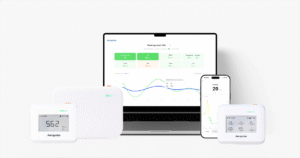
Modern IAQ devices like the Aeropulse A100 and A200 support this shift by offering reliable measurement of CO₂, VOCs, temperature, humidity, and optional pollutant capsules depending on the configuration.
The Future of Sustainable Buildings Depends on Clean Air
As buildings become smarter, greener, and more health-focused, air quality will remain a decisive factor in sustainability performance. Certifications like LEED, WELL, Fitwel, RESET, and others continue to evolve, but their message is clear:
A truly sustainable building is one that protects the health of the people inside it.
IAQ monitoring is no longer optional; it is central to delivering healthier, more efficient, and more resilient spaces.