

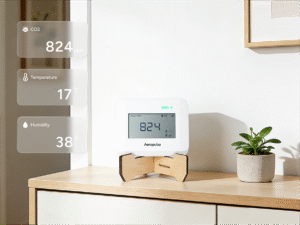
 Indoor CO₂ monitoring has rapidly shifted from a niche practice to a core part of building management across Europe. Since the COVID-19 pandemic, governments and health agencies have emphasized ventilation and indoor environmental quality as essential components of public health.
Unlike outdoor air regulations, which are EU-wide, indoor CO₂ monitoring requirements differ greatly from one country to another. Instead of a single unified law, Europe is shaped by a mix of national regulations, sector-specific mandates, and strong technical guidance.
This guide explains the current regulatory landscape, highlights key countries with the most concrete requirements, and shows how organizations can achieve compliance effectively.
Is CO₂ Monitoring Mandatory in Europe?
Short answer: No, there is no single EU law requiring CO₂ monitoring in all buildings.
However, several European countries have introduced mandatory requirements, especially in schools and public buildings, while others issue strong guidance that is widely treated as policy.
Across Europe, CO₂ monitoring is increasingly used to:
- Evaluate ventilation effectiveness
- Reduce airborne infection risks
- Improve comfort, productivity, and concentration
- Support IAQ certifications
- Provide transparency for parents, staff, and building occupants
Country Breakdown: CO₂ Monitoring Requirements in Europe (France, Spain, Netherlands)
France: Mandatory IAQ Monitoring in Schools and Public Buildings
France has one of the strongest indoor air quality (IAQ) policies in Europe. Legislation requires public buildings, including schools, daycares, and early-education facilities, to:
- Conduct periodic IAQ assessments
- Use CO₂ as a key indicator of ventilation performance
- Track, document, and respond to elevated CO₂ levels
- Maintain records for inspections and audits
This makes France one of the few European countries where CO₂ monitoring is legally compulsory in education and childcare environments.
Spain: Clear Ventilation Requirements and Widespread CO₂ Monitoring in Schools
Spain does not have a nationwide law mandating CO₂ monitors in all buildings, but strong regulations and education policies make CO₂ monitoring widespread and often required in practice.
Key points:
- National ventilation regulations require adequate airflow based on occupancy
- Many autonomous communities (regional governments) recommend or mandate CO₂ monitors in classrooms
- During and after the pandemic, education authorities made CO₂ monitoring a standard tool for ventilation assessment
- Schools are expected to maintain indoor air below 900–1000 ppm during occupied hours
While not uniformly mandated across all regions, CO₂ monitoring has become a standard compliance measure across Spanish schools and public buildings.

Netherlands: CO₂ Monitoring Embedded in Ventilation Performance Standards
The Netherlands incorporates CO₂ monitoring into its national ventilation framework, making it an essential part of school and public building compliance.
Highlights:
- The Dutch Building Decree (Bouwbesluit) sets strict ventilation requirements for classrooms and public buildings
- CO₂ levels are used as the primary indicatorof adequate ventilation
- Schools are expected to meet “Class A/B” ventilation categories, which rely directly on continuous CO₂ measurement
- Dutch Public Health Service (GGD) and education authorities recommend operational thresholds between 800–1200 ppm
- Many education boards require CO₂ monitors in all classrooms as part of routine IAQ management
This makes the Netherlands one of the most consistent adopters of CO₂ monitoring across the education sector.
Recommended CO₂ Thresholds Across Europe
Most European guidance aligns around these ventilation-based thresholds:
|
CO₂ Level (ppm) |
Meaning |
Recommended Action |
|
≤ 800 ppm |
Excellent ventilation |
No action required |
|
800–1000 ppm |
Acceptable |
Monitor and adjust |
|
1000–1500 ppm |
Poor ventilation |
Increase ventilation |
|
> 1500 ppm |
Very poor |
Take corrective action |
Although occupational exposure limits can be much higher (5,000 ppm), these relate toxicity, not ventilation quality.
For comfort, performance, and infection control, 1000 ppm is the widely accepted upper limit.
Why CO₂ Monitoring Matters for Compliance and Certification
Even when not legally required, continuous CO₂ monitoring is foundational for health-focused frameworks:
- WELL Building Standard
- RESET Air Certification
- Local IAQ compliance programs
- Healthy Workplace certifications
These frameworks rely on real-time data, stored logs, and transparent reporting making CO₂ monitoring essential for audits and long-term compliance.
How Organizations Can Comply with European CO₂ Requirements
1. Understand Your Local Regulations
France, Spain, and the Netherlands each have specific ventilation and monitoring expectations especially for schools.
2. Deploy Continuous CO₂ Monitoring
Continuous measurement with stored data logs is now the standard expectation.
3. Establish Clear Action Thresholds
Most organizations follow:
- 1000 ppm→ Act
- 1500 ppm→ Urgent intervention
4. Maintain Documentation
Store monitoring data, ventilation assessments, and calibration logs for compliance checks.
5. Combine CO₂ With Broader IAQ Monitoring
CO₂ measures ventilation, but PM2.5, TVOC, NOx, and temperature/humidity provide full indoor air quality insight.
How Aeropulse Devices Support European Compliance
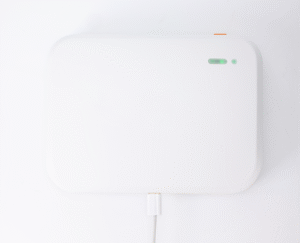
A200-CO₂
- Battery life: 365+ days
- High-accuracy CO₂ measurement
- Ideal for schools, offices, and healthcare facilities


A200-CM
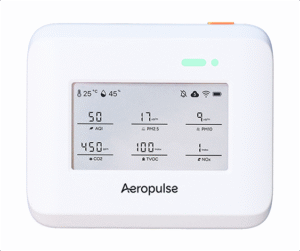
- Measures CO₂, PM2.5, PM10, TVOC, NOx, temperature, and humidity
- Suitable for countries requiring broader IAQ documentation
A100 Series (Modular Sensors)
- Interchangeable sensor capsules
- Modules available for O₃, NO₂, CO, HCHO, NH₃, and more
- Perfect for WELL, LEED, and RESET projects
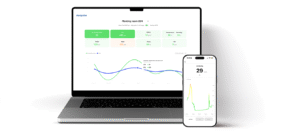
Aeropulse Dashboard
- Real-time and historical data
- Automatic threshold alerts
- Public-display mode
- Export-ready reports for audits and certifications
Final Thoughts
Europe does not have a unified CO₂ monitoring regulation, but requirements in countries like France, Spain, and the Netherlands are rapidly setting the standard for safer, healthier indoor environments.
With accurate sensors, strong ventilation insights, and transparent reporting, Aeropulse helps organizations comply with national regulations, protect occupants, and ensure trust through data-driven IAQ management.