

Understanding the invisible: Why CO₂ monitoring matters
We often think of air pollution as something that happens outdoors traffic, factories, or smog. But indoors, the air we breathe can quietly become even more polluted, especially with rising levels of carbon dioxide (CO₂). High CO₂ doesn’t just make a room feel “stuffy”; it directly affects how we think, concentrate, and feel throughout the day.
This is why CO₂ monitoring has become a fundamental part of creating healthy, productive indoor environments from offices and classrooms to hospitals and retail spaces. But how exactly do we measure something we can’t see or smell? Let’s explore the science behind it.

How CO₂ is measured?
Modern CO₂ monitors use a reliable and proven technology called Non-Dispersive Infrared (NDIR).
Here’s how it works in simple terms: inside the sensor, a tiny beam of infrared light passes through the air sample. Since CO₂ absorbs light at a specific wavelength, the sensor measures how much light is absorbed and that tells us how much CO₂ is present.
It’s a bit like shining a flashlight through fog: the denser the fog, the less light reaches the other side. The same principle applies here, except the “fog” is carbon dioxide molecules.
Why NDIR matters:
- It’s highly accurate and stable over time
- It requires very little maintenance
- It works well in most indoor environments
- It meets international standards for air monitoring, such as ASHRAE 62.1-2022
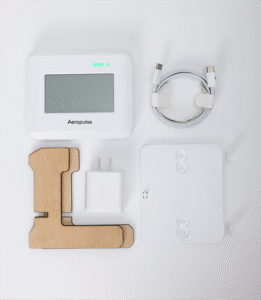 The technology inside Aeropulse CO₂ monitors
At Aeropulse, we integrate this same NDIR technology into our A200 Series a high-performance CO₂ monitor designed for reliability and precision.
Using Sensirion’s SCD43 CO2 sensor, the A200 ensures that each measurement reflects the true air quality of your indoor environment.
It doesn’t stop there; our devices also measure temperature and humidity, helping you see the full picture of indoor comfort. Whether installed in offices, classrooms, or healthcare spaces, the A200 provides continuous, real-time data to keep air quality under control.
From devices to decisions: turning data into insight
A sensor alone doesn’t make the air healthier data does.
Through the Aeropulse Dashboard and mobile App, users can access live CO₂ readings, track historical data, and receive alerts when air quality drops below healthy levels.
These connected tools help building managers and occupants take immediate action like adjusting ventilation or scheduling maintenance before CO₂ levels begin to impact wellbeing or performance.
With this combination of accurate sensing and intelligent software, Aeropulse transforms raw numbers into actionable insights.
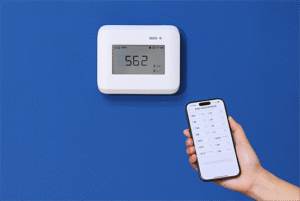
IoT and the future of smart air monitoring
CO₂ monitoring is also evolving with the Internet of Things (IoT).
IoT means that each Aeropulse device communicates with your network, sharing data automatically, no manual checking, no guesswork.
This makes it easier to manage multiple rooms, floors, or even entire buildings from one platform. It also supports WELL and LEED certification efforts, ensuring buildings meet global standards for health and sustainability.
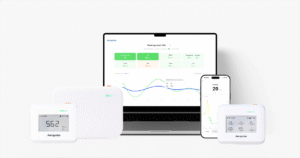
A small change with a big impact
When CO₂ levels are monitored consistently, everyone benefits.
Employees feel more alert; students stay focused longer, and facilities become healthier and more energy efficient.
Behind it all is precise, reliable sensing technology and a commitment to smarter, cleaner air.
At Aeropulse, we believe that understanding the science of air is the first step toward improving it.
Our mission is to make indoor environments healthier, safer, and more productive through intelligent air monitoring solutions.

Conclusion
CO₂ may be invisible, but its impact is not.
With advanced NDIR sensors, smart connectivity, and real-time insights, Aeropulse makes it easy to see what’s happening in the air you breathe and take control of it.