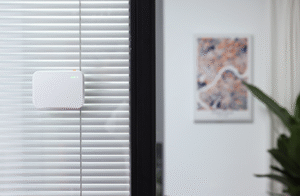

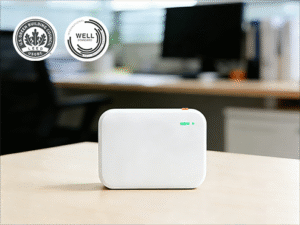
Indoor air quality is no longer a luxury; it’s a requirement. As buildings push toward WELL and LEED certification, one topic has become increasingly important: ozone (O₃).
Ozone is often misunderstood. Outdoors, it’s a protective layer. Indoors, it’s a respiratory irritant that can trigger symptoms even at low concentrations. Yet many HVAC systems, “ionizers,” and older air purifiers continue to produce ozone as a byproduct.
This is why WELL v2, WELL v3, and LEED v5 strictly address ozone limits, filtration technologies, and verification through continuous monitoring.
And this is exactly where Aeropulse provides clarity and compliance.
Why Ozone-Free Purification Matters
Some purifiers claim to “clean” air using electrostatic plates, ion generation, or ozone shock cycles. Science is clear: these technologies can create more problems than they solve.
 Indoor ozone exposure is linked to:
- Coughing, lung irritation, breathing difficulty
- Worsening asthma and allergic symptoms
- Increased respiratory inflammation
- Reactions with VOCs that create secondary pollutants (e.g., formaldehyde, ultrafine particles)
Because of this, WELL and LEED allow only low-emission or ozone-free purification technologies, and in some cases require proof that ozone stays below strict thresholds.
What WELL and LEED Require for Ozone?
WELL Building Standard
WELL Feature A08 (Air) and A12 (Air Filtration) require:
- Ozone concentrations ≤ 51 ppb (0.051 ppm)
- Use of ozone-free air purification technologies
- Continuous air quality monitoring in some project types
- Demonstration that filtration systems do NOT generate harmful byproducts
LEED v5 (Indoor Environmental Quality)
The new LEED v5 draft prioritizes:
- Verification of indoor ozone levels
- Use of equipment that does NOT generate ozone
- Reporting and documentation supported by continuous sensor data
Both frameworks emphasize the same message: Avoid ozone generation and monitor ozone continuously to prove compliance.
Why Continuous Ozone Monitoring Is Becoming Essential
Even when a building uses “ozone-free” filtration, ozone can still enter from:
- Outdoor air in polluted urban areas
- Printers, copiers, and office equipment
- Electronic devices
- Older HVAC systems
- Purifiers that claim to be ion-based but generate low ozone
This is why consultants, mechanical engineers, and WELL/LEED assessors now recommend real data, not assumptions.
Continuous ozone monitoring helps buildings:
- Detect ozone spikes immediately
- Validate purifier safety
- Confirm ventilation effectiveness
- Provide compliance evidence for WELL and LEED
- Increase transparency for occupants
How Aeropulse Supports Ozone-Free, Certification-Ready Buildings
Unlike brands that only measure CO₂ or particles, Aeropulse provides true multi-gas sensing, including O₃.
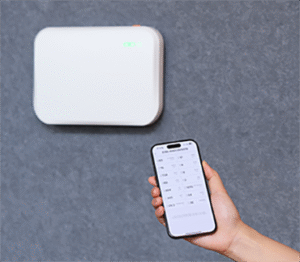
Aeropulse A100 + Ozone Capsule
The A100’s modular capsule design allows you to plug in an Ozone (O₃) sensor capsule, enabling:
-
-
- High-accuracy ozone measurement in real time
- Continuous logging with 1.5+ years of internal storage
- Wi-Fi connectivity for remote monitoring
- Live dashboards for WELL/LEED reporting
- Alerts when ozone exceeds safe thresholds
-
This makes the A100 a powerful compliance tool for WELL Feature A08, A12, and LEED IEQ credits.
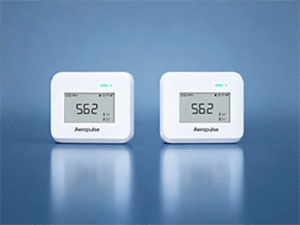 Aeropulse A200 Series
For projects requiring battery-powered flexibility, the A200 line offers:
- Ultra-long battery operation on WiFi
- CO₂ + IAQ monitoring (A200-CM)
- Integration with broader IAQ programs
- Options to complement ozone monitoring in larger deployments
The A200 pairs seamlessly with the A100 for full building coverage.
Aeropulse Dashboard
A complete cloud platform designed for professional compliance workflows:
- Real-time ozone tracking
- Threshold alerts when levels exceed WELL/LEED limits
- Historical trend reports
- Export files for certification submission
- Multi-device comparison
- Remote monitoring across sites
Aeropulse doesn’t just measure ozone; it makes the data meaningful.

Ozone-Free Buildings: A New Industry Standard
 As awareness grows, more developers and facility managers want to demonstrate that their buildings:
✔ Use safe, ozone-free purification
✔ Continuously monitor ozone to prevent exposure
✔ Provide clear and transparent IAQ data
✔ Meet global building health standards
Aeropulse helps transform these goals into measurable, verifiable performance.
Conclusion
Ozone-free purification and continuous ozone monitoring are no longer optional; they’re essential for modern, health-focused buildings.
WELL and LEED now require buildings to prove they are protecting occupants, not simply assume it.
With Aeropulse’s ozone-capable A100 sensors, long-life A200 series, and powerful dashboard, organizations can confidently achieve:
- Safer indoor environments
- WELL and LEED compliance
- Transparent air-quality reporting
- Peace of mind for occupants and stakeholders
Aeropulse delivers data. You deliver a healthy building.